When Will Comet Hale-bopp Return to Pass by the Earth Again
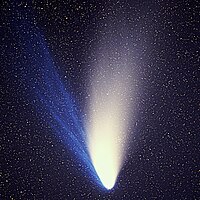 Comet Hale–Bopp, shortly after passing perihelion in Apr 1997 | |
| Discovery | |
|---|---|
| Discovered by | Alan Unhurt Thomas Bopp |
| Discovery date | July 23, 1995 |
| Culling designations | The Great Comet of 1997, C/1995 O1 |
| Orbital characteristics A | |
| Epoch | 2450460.five |
| Observation arc | eight.48 years |
| Orbit type | Long period comet |
| Aphelion | 370.eight AU[1] |
| Perihelion | 0.914 AU[2] |
| Semi-major axis | 186 AU |
| Eccentricity | 0.995086 |
| Orbital menstruum | 2520[3]–2533[1] year (Barycentric 2391 year)[iv] |
| Inclination | 89.4° |
| Dimensions | 40–80 km[1] |
| Nucleus albedo | 0.01–0.07 |
| Last perihelion | April 1, 1997[2] 2215 BC[five] |
| Adjacent perihelion | 4385 ± 2.0 AD[six] |
Comet Hale–Bopp (formally designated C/1995 O1) is a comet that was one of the most widely observed of the 20th century and i of the brightest seen for many decades.
Alan Hale and Thomas Bopp discovered Comet Hale–Bopp separately on July 23, 1995, earlier it became visible to the naked eye. It is difficult to predict the maximum brightness of new comets with any caste of certainty, but Hale–Bopp met and exceeded well-nigh predictions when information technology passed perihelion on April 1, 1997, reaching most magnitude −1.viii. Information technology was visible to the naked middle for a record xviii months, twice as long as the Great Comet of 1811, the previous record holder. Accordingly, Hale–Bopp was dubbed the great comet of 1997.
Discovery [edit]
The comet was discovered independently on July 23, 1995, by two observers, Alan Hale and Thomas Bopp, both in the United states.[7]
Unhurt had spent many hundreds of hours searching for comets without success, and was tracking known comets from his driveway in New United mexican states when he chanced upon Unhurt–Bopp just afterward midnight. The comet had an apparent magnitude of 10.5 and lay well-nigh the globular cluster M70 in the constellation of Sagittarius.[8] [9] Hale first established that there was no other deep-sky object about M70, and then consulted a directory of known comets, finding that none were known to be in this expanse of the sky. In one case he had established that the object was moving relative to the background stars, he emailed the Central Bureau for Astronomical Telegrams, the clearing house for astronomical discoveries.[10]
Bopp did not own a telescope. He was out with friends almost Stanfield, Arizona, observing star clusters and galaxies when he chanced across the comet while at the eyepiece of his friend'southward telescope. He realized he might take spotted something new when, like Hale, he checked his star maps to make up one's mind if any other deep-heaven objects were known to be about M70, and found that there were none. He alerted the Key Agency for Astronomical Telegrams through a Western Union telegram. Brian Chiliad. Marsden, who had run the agency since 1968, laughed, "Nobody sends telegrams anymore. I hateful, by the fourth dimension that telegram got here, Alan Unhurt had already eastward-mailed us three times with updated coordinates."[11]
The following forenoon, it was confirmed that this was a new comet, and it was given the designation C/1995 O1. The discovery was announced in International Astronomical Union circular 6187.[viii] [12]
Early observation [edit]
Unhurt–Bopp's orbital position was calculated as 7.2 astronomical units (AU) from the Sunday, placing information technology between Jupiter and Saturn and by far the greatest distance from Earth at which a comet had been discovered by amateurs.[13] [xiv] Nearly comets at this distance are extremely faint, and show no discernible activity, only Hale–Bopp already had an observable coma.[8] A precovery image taken at the Anglo-Australian Telescope in 1993 was found to show the so-unnoticed comet some 13 AU from the Sun,[fifteen] a distance at which most comets are substantially unobservable. (Halley's Comet was more than 100 times fainter at the aforementioned distance from the Lord's day.)[16] Analysis indicated later that its comet nucleus was 60±20 kilometres in bore, approximately six times the size of Halley'southward Comet.[one] [17]
Its nifty distance and surprising activeness indicated that comet Unhurt–Bopp might get very vivid when it reached perihelion in 1997. Still, comet scientists were wary – comets can be extremely unpredictable, and many have large outbursts at great distance merely to diminish in effulgence afterwards. Comet Kohoutek in 1973 had been touted as a 'comet of the century' and turned out to be unspectacular.[10]
Perihelion [edit]
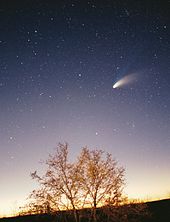
The comet became a spectacular sight in early 1997.

Star map of path with 14-solar day movement marked
Unhurt–Bopp became visible to the naked middle in May 1996, and although its rate of brightening slowed considerably during the latter half of that yr,[18] scientists were still cautiously optimistic that it would go very bright. It was likewise closely aligned with the Sunday to be observable during December 1996, just when it reappeared in January 1997 information technology was already vivid plenty to exist seen by anyone who looked for information technology, even from big cities with light-polluted skies.[19]
The Cyberspace was a growing phenomenon at the fourth dimension, and numerous websites that tracked the comet'south progress and provided daily images from around the world became extremely pop. The Internet played a large role in encouraging the unprecedented public interest in comet Hale–Bopp.[20]
As the comet approached the Sun, it continued to brighten, shining at 2nd magnitude in February, and showing a growing pair of tails, the blue gas tail pointing direct away from the Dominicus and the xanthous dust tail curving away along its orbit. On March ix, a solar eclipse in Mainland china, Mongolia and eastern Siberia allowed observers there to see the comet in the daytime.[21] Hale–Bopp had its closest approach to Earth on March 22, 1997, at a distance of 1.315 AU.[22]
Every bit it passed perihelion on April ane, 1997, the comet developed into a spectacular sight. It shone brighter than any star in the sky except Sirius, and its grit tail stretched forty–45 degrees across the heaven.[23] [24] The comet was visible well before the heaven got fully night each nighttime, and while many great comets are very close to the Dominicus equally they pass perihelion, comet Hale–Bopp was visible all night to northern hemisphere observers.[25]
Afterwards perihelion [edit]
After its perihelion passage, the comet moved into the southern celestial hemisphere. The comet was much less impressive to southern hemisphere observers than it had been in the northern hemisphere, simply southerners were able to see the comet gradually fade from view during the second half of 1997. The last naked-heart observations were reported in Dec 1997, which meant that the comet had remained visible without assist for 569 days, or about 18 and a one-half months.[18] The previous tape had been gear up by the Great Comet of 1811, which was visible to the naked eye for about ix months.[xviii]
The comet continued to fade as it receded, but was still tracked by astronomers. In October 2007, 10 years after the perihelion and at distance of 25.vii AU from Lord's day, the comet was still active as indicated past the detection of the CO-driven coma.[26] Herschel Space Observatory images taken in 2010 suggest comet Hale–Bopp is covered in a fresh frost layer.[27] Hale–Bopp was again detected in December 2010 when it was 30.vii AU abroad from the Sun,[28] and on Baronial 7, 2012, at a 33.2 AU distance from the Sun.[29]
Orbital changes [edit]

Hale–Bopp at perihelion on April 1, 1997
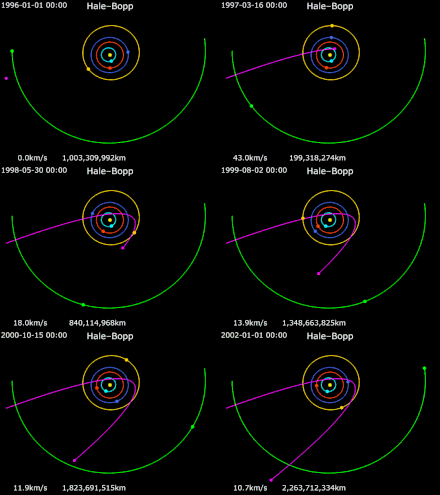
Polar view

Equatorial view
The comet likely made its previous perihelion 4,200 years ago,[30] in July 2215 BC.[5] The estimated closest approach to Earth was one.iv AU, and it may have been observed in ancient Arab republic of egypt during the 6th dynasty reign of the Pharaoh Pepi 2 (Reign: 2247 – c. 2216 BC). Pepi's pyramid at Saqqara contains a text referring to an "nhh-star" every bit a companion of the pharaoh in the heavens, where " nhh " is the hieroglyph for long hair.[31]
Hale–Bopp may have had a near standoff with Jupiter in early on June 2215 BC, which probably caused a dramatic change in its orbit, and 2215 BC may have been its first passage through the inner Solar Arrangement from the Oort cloud.[5] The comet's current orbit is almost perpendicular to the airplane of the ecliptic, so farther close approaches to planets volition be rare. However, in April 1996 the comet passed within 0.77 AU of Jupiter, close plenty for its orbit to be measurably affected past the planet's gravity.[30] The comet'southward orbit was shortened considerably to a menses of roughly 2,533 years,[1] and it will next return to the inner Solar Arrangement around the year 4385.[6] Its greatest distance from the Sun (aphelion) volition be nearly 370 AU,[one] reduced from well-nigh 525 AU.[5] [32]
The estimated probability of Hale-Bopp's striking Earth in future passages through the inner Solar Organisation is remote, about 2.5×x−ix per orbit.[33] Nonetheless, given that the comet nucleus is around lx km in diameter,[1] the consequences of such an impact would be apocalyptic. Weissman conservatively estimates the bore at 35 km; an estimated density of 0.6 g/cm3 then gives a cometary mass of 1.3×ten19 k. At a probable impact velocity of 52.5 km/southward, bear on free energy tin can be calculated as i.nine×x32 ergs, or 4.4×ten9 megatons, virtually 44 times the estimated energy of the K-T impact effect.[33]
Over many orbits, the cumulative event of gravitational perturbations on comets with high orbital inclinations and pocket-sized perihelion distances is generally to reduce the perihelion distance to very pocket-size values. Hale–Bopp has about a 15% risk of eventually becoming a sungrazing comet through this procedure.[34]
Scientific results [edit]
Comet Hale–Bopp was observed intensively by astronomers during its perihelion passage, and several important advances in cometary scientific discipline resulted from these observations. The dust product rate of the comet was very loftier (up to ii.0×x half-dozen kg/southward),[35] which may have fabricated the inner coma optically thick.[36] Based on the backdrop of the dust grains—high temperature, high albedo and stiff ten μm silicate emission feature—the astronomers ended the grit grains are smaller than observed in any other comet.[37]
Hale–Bopp showed the highest ever linear polarization detected for whatever comet. Such polarization is the result of solar radiations getting scattered by the dust particles in the coma of the comet and depends on the nature of the grains. It farther confirms that the dust grains in the blackout of comet Hale–Bopp were smaller than inferred in whatever other comet.[38]
Sodium tail [edit]

Comet Unhurt–Bopp'south neutral sodium tail (the direct tail extending up to the left from the nucleus)[39]
One of the most remarkable discoveries was that the comet had a 3rd type of tail. In addition to the well-known gas and dust tails, Unhurt–Bopp likewise exhibited a faint sodium tail, only visible with powerful instruments with dedicated filters. Sodium emission had been previously observed in other comets, but had not been shown to come up from a tail. Hale–Bopp's sodium tail consisted of neutral atoms (non ions), and extended to some 50 1000000 kilometres in length.[39]
The source of the sodium appeared to exist the inner coma, although not necessarily the nucleus. In that location are several possible mechanisms for generating a source of sodium atoms, including collisions betwixt dust grains surrounding the nucleus, and "sputtering" of sodium from dust grains by ultraviolet light. It is not withal established which mechanism is primarily responsible for creating Hale–Bopp'southward sodium tail, and the narrow[39] and diffuse[40] components of the tail may have unlike origins.[41]
While the comet's dust tail roughly followed the path of the comet's orbit and the gas tail pointed almost directly away from the Sun, the sodium tail appeared to lie between the two. This implies that the sodium atoms are driven abroad from the comet's caput by radiation force per unit area.[39]
Deuterium affluence [edit]
The abundance of deuterium in comet Hale–Bopp in the course of heavy h2o was found to be about twice that of Earth's oceans. If Hale–Bopp's deuterium abundance is typical of all comets, this implies that although cometary impacts are thought to exist the source of a significant amount of the h2o on Earth, they cannot be the only source.[42]
Deuterium was also detected in many other hydrogen compounds in the comet. The ratio of deuterium to normal hydrogen was found to vary from compound to compound, which astronomers believe suggests that cometary ices were formed in interstellar clouds, rather than in the solar nebula. Theoretical modelling of ice formation in interstellar clouds suggests that comet Hale–Bopp formed at temperatures of around 25–45 kelvins.[42]
Organics [edit]
Spectroscopic observations of Hale–Bopp revealed the presence of many organic chemicals, several of which had never been detected in comets before. These complex molecules may be within the cometary nucleus, or might be synthesised past reactions in the comet.[43]
Detection of argon [edit]
Hale–Bopp was the commencement comet where the noble gas argon was detected.[44] Noble gases are chemically inert and vary from low to high volatility. Since different noble elements have different sublimation temperatures, and don't interact with other elements, they can be used for probing the temperature histories of the cometary ices. Krypton has a sublimation temperature of 16–twenty K and was establish to exist depleted more than 25 times relative to the solar abundance,[45] while argon with its higher sublimation temperature was enriched relative to the solar affluence.[44] Together these observations betoken that the interior of Unhurt–Bopp has e'er been colder than 35–xl Thou, simply has at some indicate been warmer than xx K. Unless the solar nebula was much colder and richer in argon than generally believed, this suggests that the comet formed across Neptune in the Kuiper belt region and then migrated outward to the Oort cloud.[44]
Rotation [edit]
Comet Hale–Bopp'due south activeness and outgassing were not spread uniformly over its nucleus, but instead came from several specific jets. Observations of the material streaming away from these jets[46] allowed astronomers to measure the rotation period of the comet, which was institute to be most xi hours 46 minutes.[47]
Binary nucleus question [edit]
In 1997 a paper was published that hypothesised the existence of a binary nucleus to fully explain the observed pattern of comet Unhurt–Bopp'south grit emission observed in October 1995. The paper was based on theoretical analysis, and did not merits an observational detection of the proposed satellite nucleus, simply estimated that it would have a diameter of most xxx km, with the main nucleus being most 70 km across, and would orbit in about three days at a distance of about 180 km.[48] This analysis was confirmed by observations in 1996 using Wide-Field Planetary Camera 2 of the Hubble Space Telescope which had taken images of the comet that revealed the satellite.[49]
Although observations using adaptive optics in late 1997 and early 1998 showed a double peak in the brightness of the nucleus,[50] controversy still exists over whether such observations can only be explained by a binary nucleus.[17] The discovery of the satellite was not confirmed past other observations.[51] [52] Also, while comets have been observed to break up before,[53] no instance had been found of a stable binary nucleus until the subsequent discovery of P/2006 VW139 .
UFO claims [edit]
In November 1996, apprentice astronomer Chuck Shramek of Houston, Texas took a CCD epitome of the comet which showed a fuzzy, slightly elongated object nearby. His computer heaven-viewing program did not identify the star, then Shramek called the Fine art Bong radio plan Coast to Declension AM to announce that he had discovered a "Saturn-like object" following Hale–Bopp. UFO enthusiasts, such as remote viewing proponent and Emory University political science professor Courtney Chocolate-brown, soon ended that there was an conflicting spacecraft following the comet.[54]
Several astronomers stated that the object was simply the 8.5-magnitude star SAO141894, including Alan Hale.[55] They noted that the star did not announced on Shramek'south figurer program because the user preferences were prepare incorrectly.[56] Fine art Bell claimed to have obtained an image of the object from an bearding astrophysicist who was about to confirm its discovery. Notwithstanding, astronomers Olivier Hainaut and David Tholen of the University of Hawaii stated that the alleged photo was an altered copy of one of their own comet images.[57]
Thirty-nine members of the Heaven's Gate cult committed mass suicide in March 1997 with the intention of teleporting to a spaceship which they believed was flying backside the comet.[58]
Nancy Lieder, who claims to receive messages from aliens through an implant in her encephalon, stated that Unhurt–Bopp was a fiction designed to distract the population from the coming arrival of "Nibiru" or "Planet X", a behemothic planet whose close passage would disrupt the World'southward rotation, causing global calamity.[59] Her original date for the apocalypse was May 2003, which passed without incident, but diverse conspiracy websites continued to predict the coming of Nibiru, most of whom tied it to the 2012 miracle.[threescore] Lieder and others' claims of the planet Nibiru take been repeatedly debunked by scientists.[61]
Legacy [edit]

Comet Unhurt–Bopp in 2001, at a distance of nearly 2 billion kilometres from the Sunday. Credit: ESO
Its lengthy menstruum of visibility and extensive coverage in the media meant that Hale–Bopp was probably the most-observed comet in history, making a far greater impact on the general public than the return of Halley's Comet in 1986, and certainly seen past a greater number of people than witnessed any of Halley'southward previous appearances. For instance, 69% of Americans had seen Hale–Bopp by April ix, 1997.[62]
Hale–Bopp was a record-breaking comet—the farthest comet from the Sunday discovered past amateurs,[22] with the largest well-measured cometary nucleus known afterward 95P/Chiron,[17] and it was visible to the naked eye for twice as long as the previous record-holder.[18] It was likewise brighter than magnitude 0 for eight weeks, longer than any other recorded comet.[22]
Carolyn Shoemaker and her husband Gene, both famous for co-discovering comet Shoemaker–Levy nine, were involved in a car crash afterwards photographing the comet. Gene died in the crash and his ashes were sent to the Moon aboard NASA'southward Lunar Prospector mission along with an image of Hale–Bopp, "the final comet that the Shoemakers observed together".[63]
Come across also [edit]
- Comet Hyakutake
- Hale Bopp (Waterhouse), a 1997 string orchestra composition
- Lists of comets
References [edit]
- ^ a b c d e f 1000 "JPL Pocket-sized-Body Database Browser: C/1995 O1 (Hale–Bopp)" (2007-10-22 terminal obs). Retrieved December five, 2008.
- ^ a b "JPL SBDB Epoch 1996".
- ^ Syuichi Nakano (February 12, 2008). "OAA computing section round NK 1553". OAA Computing and Minor Planet Sections. Retrieved Dec 17, 2009.
- ^ Horizons output. "Barycentric Osculating Orbital Elements for Comet C/1995 O1 (Hale-Bopp)". Retrieved January 31, 2011. (Solution using the Solar System Barycenter and barycentric coordinates. Select Ephemeris Type:Elements and Heart:@0)
- ^ a b c d Marsden, B. G. (1997). "Orbit Determination and Development of Comet C/1995 O1 (Hale-Bopp)". Earth, Moon, and Planets. 79 (ane): iii–15. Bibcode:1997EM&P...79....3M. doi:10.1023/A:1006268813208. S2CID 121368997.
- ^ a b "Solex ten estimate for Side by side Perihelion of C/1995 O1 (Hale-Bopp)". Archived from the original on Baronial 10, 2012. Retrieved December 18, 2009.
- ^ Shanklin, Jonathan D. (2000). "The comets of 1995". Journal of the British Astronomical Association. 110 (6): 311. Bibcode:2000JBAA..110..311S.
- ^ a b c Hale, A.; Bopp, T.; Stevens, J. (July 23, 1995). "IAU Circular No. 6187". IAU. Retrieved July 5, 2011.
- ^ Mobberley, Martin (2013), It Came From Outer Infinite Wearing an RAF Blazer!: A Fan's Biography of Sir Patrick Moore, Springer Science & Concern Media, p. 483, ISBN978-3319006093
- ^ a b Lemonick, Michael D. (March 17, 1997). "Comet of the decade Part 2". Fourth dimension. Archived from the original on November thirty, 2008. Retrieved October 30, 2008.
- ^ Newcott, William (December 1997). "The Age of Comets". National Geographic Society . Retrieved December seven, 2009.
Nobody sends telegrams anymore...
- ^ Bopp, Thomas (1997). "Amateur Contributions in the written report of Comet Hale–Bopp". Earth, Moon, and Planets. 79 (1–3): 307–308. Bibcode:1997EM&P...79..307B. doi:10.1023/A:1006262006364. S2CID 117124838.
- ^ Marsden, B. G. (1995). "Comet C/1995 O1 (Unhurt-Bopp)". Minor Planet Electronic Round. 1995-P05.
- ^ Kidger, M. R.; Serra-Ricart, Miquel; Bellot-Rubio, Luis R.; Casas, Ricard (1996). "Evolution of a Spiral Jet in the Inner Blackout of Comet Unhurt-Bopp (1995 O1)". The Astrophysical Journal Letters. 461 (ii): L119–L122. Bibcode:1996ApJ...461L.119K. doi:10.1086/310008.
- ^ McNaught, R. H.; West, R. M. (August 2, 1995). "Circular No. 6198". IAU. Retrieved July 5, 2011.
- ^ Biver, N.; Rauer, H; Despois, D; Moreno, R; Paubert, G; Bockelée-Morvan, D; Colom, P; Crovisier, J; et al. (1996). "Substantial outgassing of CO from Comet Hale–Bopp at large heliocentric altitude". Nature. 380 (6570): 137–139. Bibcode:1996Natur.380..137B. doi:ten.1038/380137a0. PMID 8600385. S2CID 4342525.
- ^ a b c Fernández, Yanga R. (2002). "The Nucleus of Comet Hale-Bopp (C/1995 O1): Size and Activity". World, Moon, and Planets. 89 (1): 3–25. Bibcode:2002EM&P...89....3F. doi:ten.1023/A:1021545031431. S2CID 189899565.
- ^ a b c d Kidger, M.R.; Hurst, G.; James, N. (2004). "The Visual Light Curve Of C/1995 O1 (Hale-Bopp) From Discovery To Late 1997". Earth, Moon, and Planets. 78 (1–3): 169–177. Bibcode:1997EM&P...78..169K. doi:x.1023/A:1006228113533. S2CID 120776226.
- ^ Browne, Malcolm R. (March 9, 1997). "Comet Holds Clues to Birth of Fourth dimension". The New York Times.
- ^ "The Trail of Hale-Bopp". Scientific American. March 17, 1997. Retrieved October 23, 2008.
- ^ McGee, H. W.; Poitevin, P. (1997). "The total solar eclipse of 1997 March ix". Periodical of the British Astronomical Association. 107 (3): 112–113. Bibcode:1997JBAA..107..112M.
- ^ a b c "Comet Hale-Bopp". Stardust. Jet Propulsion Laboratory, NASA. November 26, 2003. Retrieved Oct 9, 2008.
- ^ Due west, Richard One thousand. (April 13, 1997). "Comet Hale-Bopp (April 13, 1997)". European Southern Observatory. Archived from the original on May 24, 2011. Retrieved November 23, 2008.
- ^ Shylaja, B. S. (1997). "What's New With Hale Bopp?". Message of the Astronomical Society of India. 25: 155–156. Bibcode:1997BASI...25..155S.
- ^ Westward, Richard 1000. (March 7, 1997). "Comet Hale-Bopp (March 7, 1997)". European Southern Observatory. Archived from the original on May 24, 2011. Retrieved November 25, 2008.
- ^ Szabó, Gy. M.; Kiss, 50. L.; Sárneczky, One thousand. (2008). "Cometary Activity at 25.seven AU: Unhurt-Bopp xi Years after Perihelion". Astrophysical Periodical Letters. 677 (two): 121. arXiv:0803.1505. Bibcode:2008ApJ...677L.121S. doi:10.1086/588095. S2CID 13344162.
- ^ Szabó, Gy. M.; Buss, L. Fifty.; Kiss, Cs.; Pál, A.; Sárneczky, Thousand.; Juhász, A.; Hogerheijde, M. R. (2012). "Prove for fresh frost layer on the blank nucleus of comet Hale—Bopp at 32 AU distance". Astrophysical Journal. 761 (one): 8. arXiv:1210.2785. Bibcode:2012ApJ...761....8S. doi:ten.1088/0004-637X/761/1/8. S2CID 119197339.
- ^ Szabó, M.; Sárneczky, K.; Osculation, 50. L. (2011). "Frozen to decease? – Detection of comet Hale-Bopp at 30.seven AU". Globe and Planetary Astrophysics. 1104: 4351. arXiv:1104.4351. Bibcode:2011A&A...531A..11S. doi:10.1051/0004-6361/201116793. S2CID 119113598.
- ^ Dave Herald (August vii, 2012). "Comet Hale-Bopp C/1995 O1 - observed tonite". Yahoo Groups. Retrieved Baronial 9, 2012.
- ^ a b Yeomans, Don (April x, 1997). "Comet Hale-Bopp Orbit and Ephemeris Information". JPL/NASA. Retrieved October 23, 2008.
- ^ "The Lost Tomb", Kent Weeks, ISBN 0-297-81847-3, page 198
- ^ Williams, David R. (December 23, 2005). "Comet Fact Sheet". NASA (National Space Science Data Middle). Retrieved Dec 5, 2008. (pre-perturbation orbit: semi-major axis 250AU; flow 4000yr)
- ^ a b Weissman, Paul R. (2007). "The cometary impactor flux at the Earth". Proceedings of the International Astronomical Union. Cambridge University Press. 2 (S236): 441–450. Bibcode:2007IAUS..236..441W. doi:x.1017/S1743921307003559. ISBN978-0-521-86345-2.
- ^ Bailey, M. Eastward.; Emel'Yanenko, V. V.; Hahn, G.; Harris, N. Westward.; Hughes, K. A.; Muinonen, 1000.; Scotti, J. V. (1996). "Orbit Decision and Evolution of Comet C/1995 O1 (Unhurt-Bopp)". Monthly Notices of the Royal Astronomical Society. 281 (one): 916–924. Bibcode:1996MNRAS.281..916B. CiteSeerX10.one.1.29.6010. doi:10.1093/mnras/281.iii.916.
- ^ Jewitt, David; Matthews, Henry (1999). "Particulate Mass Loss from Comet Hale-Bopp". The Astronomical Journal. 117 (2): 1056–1062. Bibcode:1999AJ....117.1056J. doi:10.1086/300743. S2CID 120740179.
- ^ Fernández, Yanga R.; Wellnitz, Dennis D.; Buie, Marc W.; Dunham, Edward West.; Millis, Robert 50.; Nye, Ralph A.; Stansberry, John A.; Wasserman, Lawrence H.; a'Hearn, Michael F.; Lisse, Carey M.; Golden, Meg E.; Person, Michael J.; Howell, Robert R.; Marcialis, Robert L.; Spitale, Joseph N. (1999). "The Inner Blackout and Nucleus of Comet Hale–Bopp: Results from a Stellar Occultation". Icarus. 140 (1): 205–220. Bibcode:1999Icar..140..205F. doi:10.1006/icar.1999.6127. S2CID 43229796.
- ^ Stonemason, C. G.; Gehrz, R. D.; Jones, T. J.; Woodward, C E.; Hanner, Thousand. S.; Williams, D. M. (2001). "Observations of Unusually Modest Dust Grains in the Coma of Comet Hale-Bopp C/1995 O1". The Astrophysical Periodical. 549 (1): 635–646. Bibcode:2001ApJ...549..635M. doi:10.1086/319039.
- ^ Ganesh, Southward.; Joshi, U. C.; Baliyan, Chiliad. S.; Deshpande, One thousand. R. (1998). "Polarimetric observations of the comet Unhurt-Bopp". Astronomy and Astrophysics Supplement. 129 (5): 489–493. Bibcode:1998A&AS..129..489G. doi:x.1051/aas:1998201.
- ^ a b c d Cremonese, Yard; Boehnhardt, H; Crovisier, J; Rauer, H; Fitzsimmons, A; Fulle, M; Licandro, J; Pollacco, D; et al. (1997). "Neutral Sodium from Comet Hale–Bopp: A Third Type of Tail". The Astrophysical Journal Letters. 490 (two): L199–L202. arXiv:astro-ph/9710022. Bibcode:1997ApJ...490L.199C. doi:10.1086/311040. S2CID 119405749.
- ^ Wilson, J. K.; Baumgardner, J.; Mendillo, M. (1998). "Three tails of comet Hale-Bopp". Geophysical Inquiry Letters. 25 (iii): 225–228. Bibcode:1998GeoRL..25..225W. doi:10.1029/97GL03704.
- ^ Cremonese, G.; Fulle, Marco (1997). "Sodium In Comets". Earth, Moon, and Planets. 79 (one): 209–220. Bibcode:1997EM&P...79..209C. doi:x.1023/A:1006245619568. S2CID 118693620.
- ^ a b Meier, Roland; Owen, Tobias C. (1999). "Cometary Deuterium". Infinite Science Reviews. 90 (ane–2): 33–43. Bibcode:1999SSRv...xc...33M. doi:10.1023/A:1005269208310. PMID 11543290. S2CID 34317575.
- ^ Rodgers, S. D.; Charnley, Due south. B. (2002). "Organic synthesis in the coma of Comet Hale–Bopp?". Monthly Notices of the Royal Astronomical Society. 320 (4): L61–L64. Bibcode:2001MNRAS.320L..61R. doi:x.1046/j.1365-8711.2001.04208.ten.
- ^ a b c Stern, S. A.; Slater, D. C.; Festou, K. C.; Parker, J. Wm.; Gladstone, G. R.; A'hearn, M. F.; Wilkinson, Eastward. (2000). "The Discovery of Argon in Comet C/1995 O1 (Unhurt-Bopp)". The Astrophysical Journal. 544 (two): L169–L172. arXiv:astro-ph/0011327. Bibcode:2000ApJ...544L.169S. doi:10.1086/317312. S2CID 16759616.
- ^ Krasnopolsky, Vladimir A.; Mumma, MJ; Abbott, One thousand; Flynn, BC; Meech, KJ; Yeomans, DK; Feldman, PD; Cosmovici, CB (1997). "Detection of Soft X-rays and a Sensitive Search for Noble Gases in Comet Unhurt-Bopp (C/1995 O1)". Science. 277 (5331): 1488–1491. Bibcode:1997Sci...277.1488K. doi:ten.1126/science.277.5331.1488. PMID 9278508.
- ^ "Bergeron Comet Hale-Bopp Animation". Stardust. Jet Propulsion Laboratory, NASA. Retrieved October fourteen, 2008.
- ^ Warell, J.; Lagerkvist, C.-I.; Lagerros, J. S. V. (1999). "Dust continuum imaging of C/1995 O1 (Hale-Bopp): Rotation period and dust outflow velocity". Astronomy and Astrophysics Supplement Series. 136 (2): 245–256. Bibcode:1999A&Equally..136..245W. doi:ten.1051/aas:1999213.
- ^ Sekanina, Z. (1997). "Detection of a Satellite Orbiting The Nucleus of Comet Hale–Bopp (C/1995 O1)". Earth, Moon, and Planets. 77 (3): 155–163. Bibcode:1997EM&P...77..155S. doi:10.1023/A:1006230712665. S2CID 122481110.
- ^ Sekanina, Z. (1998). "Detection of a Satellite orbiting the Nucleus of Comet Hale-Bopp (C/1995 O1)". Proceedings of the First International Conference on Comet Hale-Bopp. European Organisation for Astronomical Research in the Southern Hemisphere. 77 (3): 155–163. Bibcode:1997EM&P...77..155S. doi:ten.1023/A:1006230712665. S2CID 122481110.
- ^ Marchis, F.; Boehnhardt, H.; Hainaut, O. R.; Le Mignant, D. (1999). "Adaptive optics observations of the innermost coma of C/1995 O1. Are there a "Hale" and a "Bopp" in comet Hale-Bopp?" (PDF). Astronomy & Astrophysics. 349: 985–995. Bibcode:1999A&A...349..985M. Archived from the original (PDF) on October 31, 2008. Retrieved Oct 29, 2008.
- ^ McCarthy, D. W.; Stolovy, S; Campins, H; Larson, S; Samarasinha, N; Kern, Southward (2007). "Comet Unhurt–Bopp in flare-up: Imaging the dynamics of icy particles with HST/NICMOS". Icarus. 189 (ane): 184–195. Bibcode:2007Icar..189..184M. doi:ten.1016/j.icarus.2007.01.019.
- ^ Weaver, H. A.; Feldman, P. D.; a'Hearn, Yard. F.; Arpigny, C.; Brandt, J. C.; Stern, S. A. (1999). "Post-Perihelion HST Observations of Comet Unhurt–Bopp (C/1995 O1)". Icarus. 141 (1): 1–12. Bibcode:1999Icar..141....1W. doi:10.1006/icar.1999.6159.
- ^ Sekanina, Z. (1997). "The problem of split comets revisited". Astronomy and Astrophysics Letters. 318: L5–L8. Bibcode:1997A&A...318L...5S.
- ^ Jaroff, Leon; Willwerth, James (Apr 14, 1997). "The homo who spread the myth". Time. Archived from the original on Nov 21, 2005. Retrieved October thirty, 2008.
- ^ Hale, Alan (1997). "Unhurt-Bopp Comet Madness". Skeptical Inquirer. 21 (ii): 25–28. Archived from the original on Feb 8, 2010. Retrieved December 6, 2009.
- ^ Burnham, Robert; Levy, David H. (2000). Great Comets . Cambridge Academy Printing. p. 191. ISBN978-0-521-64600-0.
- ^ Tholen, David J. (January 15, 1997). "Fraudulent employ of an IfA/UH movie". European Organisation for Astronomical Research in the Southern Hemisphere. Archived from the original on September 30, 2007. Retrieved October 14, 2008.
- ^ Robinson, Wendy Gale (2006). "Sky's Gate: The End". Journal of Reckoner-Mediated Communication. three (3). doi:10.1111/j.1083-6101.1997.tb00077.ten.
- ^ George Johnson (March 28, 1997). "Comets Breed Fear, Fascination and Web Sites". The New York Times . Retrieved September 27, 2009.
- ^ David Morrison. "The Myth of Nibiru and the Cease of the World in 2012". Skeptical Inquirer. Archived from the original on April 21, 2009. Retrieved April 28, 2009.
- ^ "Nibiru: The Nonexistent Planet". Space.com. Dec 4, 2018. Retrieved July 17, 2020.
- ^ Aguirre, Edwin L. (July 1997). "The Corking Comet of 1997". Sky and Telescope.
- ^ "Eugene Shoemaker Ashes Carried on Lunar Prospector". www2.jpl.nasa.gov.
External links [edit]
- CometBase: Comet Hale-Bopp
- Cometography.com: Comet Hale-Bopp
- NASA Unhurt-Bopp page
- Shadow and Substance.com: Static orbital diagram
- Comet Nucleus Blitheness
- Kramer, Emily A.; Fernandez, Yanga R.; Lisse, Carey Thousand.; Kelley, Michael S.P.; Woodney, Laura Thousand. (2014). "A dynamical analysis of the dust tail of Comet C/1995 O1 (Hale–Bopp) at loftier heliocentric distances". Icarus. 236: 136–145. arXiv:1404.2562. Bibcode:2014Icar..236..136K. doi:10.1016/j.icarus.2014.03.033. S2CID 119201510.
- Hale-Bopp at the JPL Minor-Body Database

Source: https://en.wikipedia.org/wiki/Comet_Hale%E2%80%93Bopp#:~:text=The%20comet's%20orbit%20was%20shortened,System%20around%20the%20year%204385.

Enviar um comentário for "When Will Comet Hale-bopp Return to Pass by the Earth Again"